
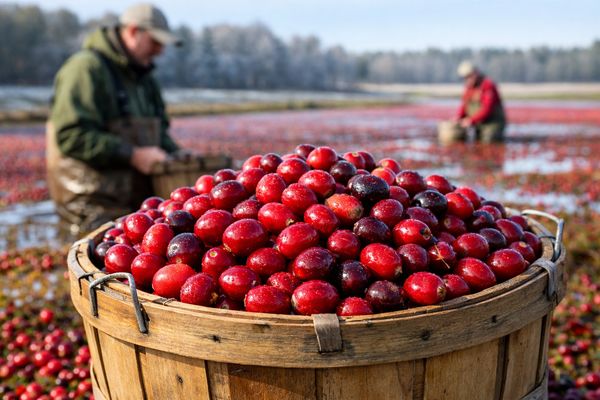
Prices for conventional US-origin dried cranberries in Europe are holding steady, with no immediate sign of either supply stress or demand-driven upside. Recent late-spring cold events in key US cranberry states raise some frost-risk headlines but come too early in the vine cycle to affect the currently marketed 2025 crop, keeping nearby price sentiment largely sideways.
European spot levels for US dried cranberries remain narrowly rangebound as buyers cover routine needs but avoid aggressive forward booking. The market is watching US weather after an unusually warm early April in New England was followed by a sharp cold snap and damaging freezes across parts of the mid-Atlantic and Northeast fruit sector. While cranberries are still in vegetative stages, repeated frost events during bud development would shift risk premiums higher later in Q2. For now, ample carryover stocks and normal trade flows keep DACH and Benelux offers stable.
Exclusive Offers on CMBroker

Cranberries dried
sliced, soft
FCA 3.80 €/kg
(from NL)

Cranberries dried
whole, classic
FCA 4.25 €/kg
(from NL)
📈 Prices
Indicative FCA Dordrecht offers for US-origin, non-organic dried cranberries are currently:
| Product | Origin | Location / Term | Latest Price (EUR/kg) | 1M Trend |
|---|---|---|---|---|
| Dried cranberries, sliced, soft | US | NL, Dordrecht – FCA | €3.80 | Flat to marginally softer vs late March |
| Dried cranberries, whole, classic | US | NL, Dordrecht – FCA | €4.25 | Flat after slight easing in late March |
Prices are effectively unchanged over the last three weeks, with only minor cent-level adjustments earlier in the month, indicating a balanced spot market and good availability of standard US material in European cold stores.
🌍 Supply & Demand
The global cranberry pipeline is still dominated by stock from the 2025 North American harvest, and recent news flow suggests no acute disruptions in processing or logistics. Major US cranberry regions (Wisconsin, Massachusetts, New Jersey) are transitioning from winter protection into early-season bog management; significant crop-size signals typically arrive later, around bloom and fruit set in June–July.
On the demand side, current trade coverage is described as routine rather than aggressive, with most industrial and retail buyers working hand-to-mouth amid broadly comfortable dried fruit availability. There are no fresh reports of export restrictions or cooperative-level marketing interventions affecting cranberry shipments, and general produce-industry headlines this week focus much more on fresh fruit and veg logistics than on processed berries.
📊 Fundamentals & Weather
Weather is the main watchpoint for US-origin cranberries. New England and mid-Atlantic agriculture have faced an abrupt swing from early-season warmth to sharp cold: local reporting across the Northeast describes farmers harvesting sensitive crops early or fearing losses after a hot-to-cold pattern in April. A separate analysis highlights a spring freeze this week delivering widespread crop damage for some mid-Atlantic farms, with record lows down to –4°C in parts of Pennsylvania on April 20–21.
Cranberry vines tolerate cold better than many tree fruits, and spring frost protection via flooding and irrigation is standard management in Massachusetts bogs. Current university guidance stresses that growers rely on tight irrigation water management and, where needed, short-duration floods to shield buds and new leaves from frost injury. At this stage, conditions are a risk factor rather than a confirmed production loss; there are no region-wide yield downgrades reported for cranberries specifically.
📆 Short-Term Outlook (3–5 days)
Regional forecasts for the US cranberry belt (New England and parts of the mid-Atlantic) show a gradual moderation after the recent freeze event, with temperatures trending back toward seasonal norms and lower immediate frost risk. However, guidance for the broader Mid-Atlantic still notes a pattern of alternating warm and cooler spells with periodic rain and breezy conditions into late April, keeping short-lived cold intrusions possible.
For the dried fruit market, this implies a steady near-term supply picture but a need to watch for any follow-up reports on bud damage if another clear, cold night pattern emerges before the calendar turns to May. No logistical disruptions from weather are currently highlighted in transport or port channels.
🧭 Trading Outlook
- For buyers: With FCA Dordrecht levels for US sliced around €3.80/kg and whole classic near €4.25/kg, and no confirmed crop issues yet, nearby coverage can continue on a spot-to-short-term basis. Consider modest additional cover into early Q3 if further frost episodes are forecast in May.
- For sellers/processors: Maintain current offer structure; the absence of bullish supply news and comfortable European stocks argues against significant price hikes. Preserve some flexibility on later-2026 shipments in case weather-driven headlines lift sentiment.
- For traders: The current flat price curve and stable basis suggest limited near-term arbitrage. Upside optionality is mainly weather-driven; watch for any credible reports of frost damage in Wisconsin or Massachusetts bogs that could justify a risk premium for 2026/27 crop positions.
📉 3-Day Price Direction (EU, FCA Dordrecht)
- Dried cranberries, sliced, soft (US origin): Stable, €3.80/kg; no significant moves expected over the next three days.
- Dried cranberries, whole, classic (US origin): Stable, €4.25/kg; trading in a tight range with a neutral bias.
- Forward outlook (into early May): Mildly weather-sensitive but still fundamentally balanced; only a sustained pattern of damaging frosts in US bog regions would shift prices meaningfully higher.
Related posts:
 Stable Dried Apple Prices as Turkish Weather Risk Stays Contained
 Dried Apricots TR: Firm FOB Malatya Prices, Weather Risk on Watch
 Dried Mango Prices Hold Firm as Thai Supply Risk Meets Vietnam Harvest
 Stable Dried Cranberry Prices as US Weather Volatility Looms
 Late Frost Risk Puts Key Orchard Crops on Alert, But Market Reaction Still Contained
 Frost Damage Threatens Orchards and Vineyards, Lifting Price Risk Across Fruit and Raisin Markets