
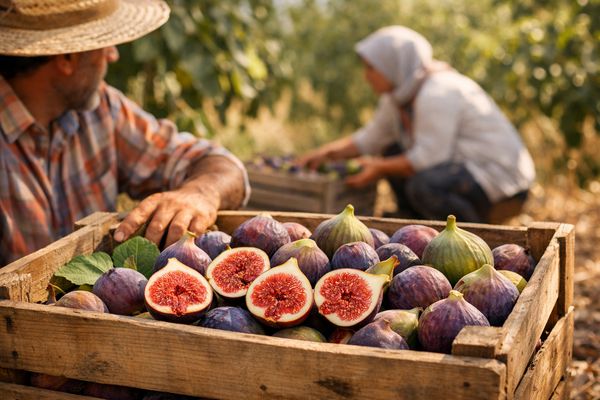
Turkish dried fig prices on an FOB Malatya basis are stable in late April, with no week‑on‑week movement across main natural and Lerida size grades, while mild, mostly sunny weather in Malatya limits immediate crop risk. A weak lira versus the euro and generally calm export demand help keep EUR-based offers in a narrow range for the coming days.
In this environment, the dried fruit complex in Türkiye is broadly steady, mirroring flat dried apricot pricing and cautious exporter behavior as markets watch weather into early May. Importers in core EU markets see little near-term supply stress in figs, and recent wholesale data show dried fig prices in Europe holding rather than rallying, reinforcing a sideways bias. With Malatya weather forecast to stay seasonally warm and mostly dry over the next three days, local physical supply chains face no immediate disruption, and short-term price risks appear modest.
Exclusive Offers on CMBroker

Figs dried
no: 7, lerida
FOB 7.60 €/kg
(from TR)

Figs dried
no: 6, natural
FOB 7.80 €/kg
(from TR)

Figs dried
no: 5, natural
FOB 8.20 €/kg
(from TR)
📈 Prices & Spreads
FOB Malatya offers for Turkish dried figs (origin TR) are unchanged between 1 April and 28 April 2026, with natural No. 7–1 grades broadly clustering around EUR 7.60–9.60/kg and Lerida No. 7–1 around EUR 7.40–10.00/kg (converted from USD at ~1.07 EUR/USD where applicable). All latest quotes dated 28 April show zero movement versus the prior week, confirming a flat near-term trend.
| Product | Grade | Location / Terms | Latest Price (EUR/kg) | 1-week Δ |
|---|---|---|---|---|
| Dried figs, natural | No. 7–1 | FOB Malatya (TR) | ≈7.60–9.60 | 0% |
| Dried figs, Lerida | No. 7–1 | FOB Malatya (TR) | ≈7.40–10.00 | 0% |
European wholesale benchmarks confirm broadly stable dried fig pricing, with Polish wholesale markets reporting dried figs around EUR 6.2–8.4/kg and no recent change. This suggests Turkish FOB offers are competitive but not aggressively discounted, aligning with a balanced, low-volatility market.
🌍 Supply, Demand & Trade Flows
Turkey remains the dominant global supplier of dried figs, with exports concentrated into the EU (Germany, France, and other core markets) and key regional hubs in the Middle East. Recent macro data show Turkey’s overall export demand index easing in March 2026, pointing to slightly softer external demand conditions across sectors, including food.
In the wider dried fruit complex, Turkish dried apricots are also trading flat to slightly firm, with exporters describing a calm market and importers well covered for nearby needs. This combination of comfortable coverage and only moderate spot interest in Europe reduces the incentive for Turkish fig packers to push prices higher in late April.
🌤 Weather & Crop Conditions (Region: TR / Malatya)
The short-term weather outlook for Malatya from 29 April to 1 May 2026 is benign: sunny to mostly sunny conditions dominate, with daytime highs around 21–23°C and cool nights near 9°C. One day of variable cloud and possible local thunderstorms is forecast on 1 May, but without indications of widespread severe events for orchards.
At the national level, Turkish agriculture is entering the new season cautiously after last year’s frost, which hit multiple fruit crops; early 2026 field reports indicate crop-specific but not universal recovery. For dried fruits in the Malatya region specifically, current late-April conditions are described as generally stable, with markets watching for any late frost or heavy rain episodes but none reported this week.
📊 Market Drivers & Fundamentals
- Currency support: The Turkish lira is trading weak against the euro (around TRY 52–53 per EUR in late April), softening EUR-based prices and helping Turkish dried fruit maintain competitiveness despite domestic cost inflation.
- Export demand tone: Broader Turkish export indicators show slight softening, suggesting buyers in some markets are cautious, which caps short-term upside for niche categories like dried figs.
- EU consumption: Recent intelligence on dried figs highlights the EU (notably Germany and France) as key demand centres, with buyers attentive to quality issues such as mould and mycotoxins but not currently signaling acute supply tightness.
- Competing dried fruit signals: Dried apricots from Turkey, another Malatya-centred export, are also in a sideways price phase, reinforcing the perception of broadly balanced supply-demand in the dried fruit complex.
📆 Short-Term Outlook & Trading Ideas
Given flat FOB Malatya prices, benign 3‑day weather, and only modest shifts in export demand indicators, the near-term bias for dried figs from Türkiye is for sideways pricing with a slight firm tone if any weather scare emerges in May.
- For buyers (roasters, packers, importers):
- Use current flat prices to cover Q2–Q3 core needs, focusing on higher grades (No. 1–3) where quality spreads are modest.
- Avoid overextending coverage far into the new-crop window until clearer indications on 2026 fig set and summer drying weather emerge.
- For Turkish exporters/packers:
- Maintain offer discipline; with EUR-based buyers price-sensitive and demand steady rather than booming, deep discounts may not be necessary.
- Highlight quality assurance and mycotoxin control to defend premiums in EU markets, where buyers remain vigilant on food safety.
- For traders:
- Expect limited volatility over the next week; opportunities lie more in relative value vs. other dried fruits (e.g., apricots, raisins) than in outright fig price moves.
📍 3-Day Directional Price Indication (Region: TR / Malatya FOB)
- Dried figs, natural No. 5–7 (FOB Malatya, EUR/kg): ~7.6–8.2; expected trend next 3 days: sideways.
- Dried figs, natural No. 1–4 (FOB Malatya, EUR/kg): ~8.8–9.6; expected trend next 3 days: sideways.
- Dried figs, Lerida No. 5–7 (FOB Malatya, EUR/kg): ~7.4–8.0; expected trend next 3 days: sideways.
- Dried figs, Lerida No. 1–4 (FOB Malatya, EUR/kg): ~8.7–10.0; expected trend next 3 days: sideways.
Related posts:
 Stable Dried Apple Prices as Turkish Weather Stays Supportive
 Banana Chips Market Holds Steady as PH–VN Weather Stays Supportive
 Turkish dried apricots: FOB Malatya flat, cubes steady in Europe as market waits on April weather
 Turkish Dried Figs: Flat FOB Malatya Prices as Buyers Trade Hand‑to‑Mouth
 Turkish Dried Apricots: Firm Malatya FOB, Weather Risk Keeps Market Alert