
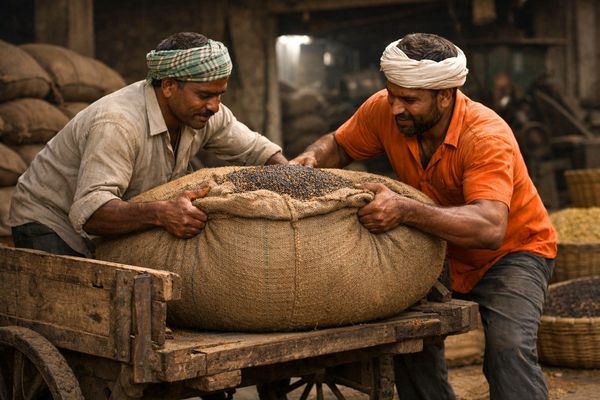
Indian mustard seed is in a mild correction as peak rabi arrivals and stockist selling weigh on prices, but the downside is limited by firm global edible oil benchmarks and stable export offers in New Delhi.
The Indian mustard complex has shifted into a classic harvest-pressure phase. Daily arrivals across key producing states have risen to their highest levels in several sessions, while oil mill buying remains selectively cautious. This has nudged domestic seed and by-product prices lower, even as wholesale benchmarks at Jaipur – the country’s bellwether market – hold broadly steady. At the same time, strengthening palm and soybean oil futures and resilient New Delhi export offers in EUR terms are cushioning mustard from a deeper sell-off and preserving export parity for European buyers.
Exclusive Offers on CMBroker

Mustard seeds
yellow, micro, sortex
99.95%
FOB 0.88 €/kg
(from IN)

Mustard seeds
yellow, bold, sortex
99.95%
FOB 0.98 €/kg
(from IN)

Mustard seeds
brown, micro, sortex
FOB 0.78 €/kg
(from IN)
📈 Prices & Current Market Tone
Conditioned mustard seed at Jaipur, India’s largest trading hub, is unchanged for a second day around a stable benchmark, signalling that the current move is a shallow correction rather than a full-blown downturn. Across the wider domestic market, however, mustard seed values have eased by roughly 25 rupees into the equivalent of about EUR 0.95–0.97 per kg, reflecting heavier arrivals and increased stockist selling.
Mustard oil benchmarks are also softer: Dadri line quotes translate to roughly EUR 1.95 per kg, while Delhi expeller-grade oil is slightly higher but still subdued. Mustard cake (sarson khalli) has slipped into the area of about EUR 0.40–0.42 per kg in the Jaipur–Kota belt, adding to the evidence of near-term pressure across the crush margin. Despite this, export offers from New Delhi for cleaned and sorted mustard seed remain broadly steady in EUR terms, with yellow sortex grades mostly clustered between about EUR 0.88–0.98 per kg FOB/FCA, and brown grades between about EUR 0.65–0.78 per kg, underscoring a stable external demand base.
| Product | Grade / Term | Location | Latest Price (EUR/kg) | 1–2 week trend |
|---|---|---|---|---|
| Mustard seed yellow, micro, sortex | FOB | New Delhi | 0.88 | Stable |
| Mustard seed yellow, bold, sortex | FOB | New Delhi | 0.98 | Stable |
| Mustard seed brown, micro, sortex | FOB | New Delhi | 0.78 | Slightly softer vs. mid‑April |
| Mustard seed brown, bold, sortex | FOB | New Delhi | 0.69 | Flat in latest quotes |
🌍 Supply, Demand & Weather Drivers
Arrivals across India’s producer mandis have climbed to about 10 lakh bags per day (c. 600,000 tonnes equivalent), up from 9.50 lakh bags in the previous session. This increase is concentrated across Rajasthan, Haryana and Madhya Pradesh as the rabi crop moves through its seasonal March–May marketing window. Traders on the ground describe farmer and stockist selling as active, particularly after recent firmness in prices encouraged hedging of on-farm inventories.
Weather conditions in the major mustard belt remain broadly favourable for late harvesting and post-harvest handling, which supports expectations of consistently high daily arrivals through May. However, forecasters and local observers flag an intensifying heat pattern over northern India as a potential emerging risk, mainly in terms of logistics and short-term quality issues rather than outright yield loss at this late crop stage. Overall crop fundamentals for India’s 2025–26 rapeseed–mustard campaign are considered comfortable, implying that domestic availability is unlikely to become a bullish driver in the near term.
📊 Linkage to Global Edible Oils
The most important counterweight to current harvest pressure is the global vegetable oil complex. Malaysian palm oil futures for nearby contracts are trading in a firm to bullish pattern, with July positions recently hovering around the mid‑4,500 ringgit per tonne area and some analysts openly discussing the possibility of a test of RM 4,800 if bullish momentum persists. This strength has been supported by energy markets and by renewed export interest into key Asian and Middle Eastern destinations.
Chicago soybean oil futures have also edged higher over the past week, with gains underpinned by crude oil strength and the broader recovery in the soybean complex. As of the latest sessions, CBOT soy contracts are trading near one‑month highs, confirming that mustard is operating within a supportive global oilseed environment. Given the structural linkage between the Indian mustard oil market and imported vegetable oils, a sustained rally in palm and soy oil prices would quickly tighten the downside in mustard seed and potentially trigger restocking from domestic oil mills.
📉 Fundamentals & Crush Margins
Crush margins remain under slight pressure as both mustard oil and cake have softened alongside seed values. With Dadri and Delhi oil quotes easing and cake prices slipping, oil mills are reluctant to chase seed aggressively at current parity, especially with arrivals still rising. This explains the described “subdued” mill demand despite an otherwise favourable export and global price backdrop.
Nevertheless, margins are not collapsing. The combination of high-frequency arrivals, decent export parity to Europe and West Asia, and firm competing vegetable oil prices keeps the crush economically viable, particularly for well-capitalised branded millers. Smaller regional crushers may remain cautious, preferring to buy hand-to-mouth until either local seed prices soften further or edible oil futures show a more decisive breakout to the upside.
📆 2–4 Week Outlook
Over the next 2–4 weeks, the base case is for Indian mustard seed prices to remain under gentle, not aggressive, pressure as arrivals peak and stockist selling persists. The domestic market is likely to see a sideways-to-slightly-softer profile in rupee terms, which should translate into broadly stable EUR-denominated export offers, assuming no sharp move in currency.
A sharp correction from here looks unlikely as long as Malaysian palm oil and Chicago soybean oil remain firm or strengthen further. To move back into a clear uptrend, the market would need either a visible reduction in daily arrivals (suggesting farmers have finished main selling) or a stronger-than-expected export pull for mustard oil and meal. European importers should therefore monitor both daily arrival statistics in key Indian mandis and the behaviour of palm and soybean oil futures in the coming weeks.
💡 Trading & Procurement Recommendations
- European crushers and packers: Use the current mild softness to extend coverage on brown and yellow grades for nearby to early Q3 positions, but scale in gradually given ongoing high arrivals.
- Indian exporters: Maintain offer discipline near current EUR levels for sortex grades; global edible oil strength suggests little need for aggressive discounting unless arrivals surge further.
- Oil mills: Continue a cautious, staggered procurement strategy while daily arrivals stay near 10 lakh bags; watch for any acceleration in palm/soy oil rallies as a cue to lock in additional seed volumes.
- Speculative participants: Bias slightly to the long side on deep intraday dips, but avoid chasing strength until there is clearer evidence that arrivals have peaked.
📍 3‑Day Directional Outlook (EUR-based)
- Jaipur mustard seed (domestic benchmark, EUR equivalent): Slight downside to sideways; modest intraday volatility possible but no strong trend break expected.
- New Delhi export offers (FOB/FCA, yellow & brown): Largely stable in EUR/kg, with only grade-specific adjustments as sellers test buyer appetite.
- Mustard oil (Dadri/Delhi, EUR equivalent): Slightly firmer bias if palm and soy oil continue to edge higher; otherwise broadly rangebound.
Related posts:
 Mustard Seeds Retreat But Stay Supported as Oil Demand Softens
 Indian Mustard Seed Prices Firm as Arrivals Tighten and Oil Complex Stays Mixed
 Indian Mustard Seed Prices Ease as Heatwave Builds Over Key Growing Belt
 Indian Mustard Seed Prices Ease as New Crop Pressure Builds
 Indian Mustard Seed Prices Edge Higher as Arrivals Slow and Weather Stays Supportive
 Indian Mustard Seed Prices Under Pressure Despite Lower Arrivals
 Indian Mustard Seed FOB Prices Edge Lower as New Crop Arrivals Build
 Indian Mustard Seed FOB New Delhi: Mild Softening as New Crop Flows Build