
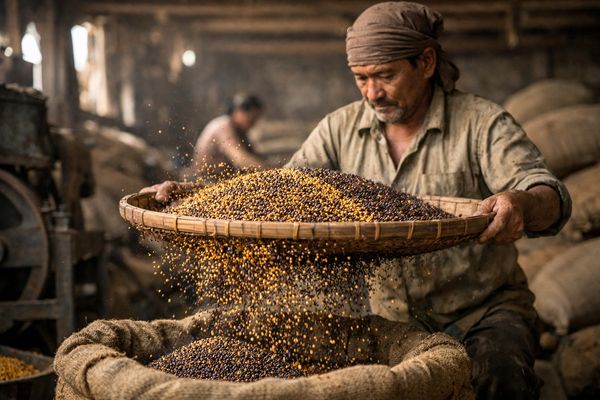
India’s mustard seed market has eased from recent highs as oil mill buying cooled and international edible oil benchmarks weakened, but tight fundamentals are preventing a sharp sell-off. Prices are expected to stay range-bound in the short term, with any fresh upside depending on a recovery in mustard oil demand or a rebound in global vegetable oil markets.
After a brief speculative and industrial-led spike, mustard seed prices in key Indian mandis have corrected in an orderly fashion. Benchmark condition mustard in Jaipur is steady around recent levels, even as Delhi local loose mustard has slipped roughly $4.30 per quintal over the month on weaker oil mill demand. Daily arrivals near 9–9.5 lakh bags and a slightly higher Rabi crop estimate around 117.25 lakh tonnes point to comfortable supply, yet not enough to trigger a deep downturn. European buyers and condiment manufacturers should prepare for a consolidation phase rather than a trend break at origin.
Exclusive Offers on CMBroker

Mustard seeds
yellow, micro, sortex
99.95%
FOB 0.88 €/kg
(from IN)

Mustard seeds
yellow, bold, sortex
99.95%
FOB 0.98 €/kg
(from IN)

Mustard seeds
brown, bold, sortex
99.95%
FOB 0.69 €/kg
(from IN)
📈 Prices & Market Mood
In Jaipur, condition mustard seed – the key reference grade for oil mills – is quoted near $77.33 per quintal, unchanged on the week but below recent peaks. In Delhi, local loose mustard trades around $71.45–$71.99 per quintal, with Najafgarh quotes clustering in the mid-$60s per quintal and Alwar-Khairtal supplies in the low $70s. Agra-line mustard remains at a premium near $83.25 per quintal, reflecting stronger regional demand and quality differentials.
Over the past month, Delhi local mustard has fallen by about $4.30 per quintal from its upper band, tracking softer refined mustard oil offtake. Export-grade Indian mustard seeds ex New Delhi currently indicate roughly EUR 0.68–0.98/kg for brown and yellow, sortex-quality lots (FOB/FCA), broadly consistent with the mild correction seen in domestic mandi prices. The overall tone is one of consolidation rather than distress selling.
🌍 Supply & Demand Balance
Daily arrivals across Rajasthan, Uttar Pradesh, Gujarat, Maharashtra, Haryana, Chhattisgarh and Bihar are holding near 9–9.50 lakh bags, suggesting a steady flow of farmer selling but no panic liquidation. The latest seminar-based Rabi estimate pegs mustard production at about 117.25 lakh tonnes versus 115 lakh tonnes last season, pointing to a marginally larger crop and broadly adequate supplies.
On the demand side, the key drag comes from oil mills, where buying has slowed in response to weaker refined mustard oil sales and cheaper competing oils. This has removed the speculative and industrial buying layer that previously propelled prices higher. However, sustained protein demand has lent support to mustard oilcake, with prices in Jaipur and Bharatpur firming toward the low-$30s per quintal equivalent, underscoring a still-solid feed demand base.
📊 Product Chain & External Drivers
Mustard oil prices have adjusted downward: in Jaipur, cold-pressed (kachi ghani) eased by about ₹10 per 10 kg to the equivalent of roughly $1.54 per 10 kg, while Kolkata kachi ghani slipped similarly to around $1.66 per 10 kg. This softening has directly curbed oil mill crush margins and appetite for seed at higher levels. In contrast, strengthening oilcake values around $29.97–$30.73 per quintal partly offset weaker oil, but not enough to trigger renewed aggressive seed procurement.
International vegetable oil benchmarks are also acting as a cap. Malaysian palm oil futures recently fell about 1.06% to near 4,579 ringgit per tonne, and Chicago soybean oil futures also declined, trimming the import parity support that had underpinned domestic mustard oil prices earlier. Unless palm and soy oil rebound, mustard’s ability to break substantially higher on its own appears limited in the immediate term.
📆 Short-Term Outlook (2–4 Weeks)
Market participants broadly expect mustard seed prices to oscillate within a relatively narrow band of roughly ₹200–₹300 per quintal, without a pronounced upside or downside breakout. Comfortable – but not burdensome – supplies and a cautious oil mill sector argue for range-bound trading. Any notable bullish impulse will likely require a visible pick-up in mustard oil consumption or a firmer tone in global edible oil markets restoring import-parity support.
For European oilseed buyers and mustard condiment manufacturers, this implies a window of relatively stable origin pricing. Forward coverage can be approached selectively, as the risk of a sharp near-term rally appears modest, but the still-tight underlying balance and firm oilcake suggest downside from current levels is also limited.
🧭 Trading Recommendations
- Importers/Condiment Manufacturers: Use the current consolidation to secure partial coverage for the next 1–2 months, especially for premium grades, while avoiding over-commitment in case global oils remain soft.
- Oil Mills: Maintain hand-to-mouth buying and monitor refined oil demand and palm/soy oil futures; consider increasing seed coverage only if product offtake and margins visibly improve.
- Producers/Farmers: Avoid distress sales at current levels; stagger marketings given limited downside and the potential for modest rebounds if external edible oil markets recover.
- Speculators: Favor range-trading strategies over directional bets, with tight risk limits around the anticipated ₹200–₹300 per quintal band.
📍 3-Day Price Indication (Directional)
| Market | Product | Indicative Level (EUR/tonne) | 3-Day Bias |
|---|---|---|---|
| Jaipur | Condition mustard seed | ≈ EUR 700–720 | Sideways |
| Delhi (local) | Loose mustard seed | ≈ EUR 640–670 | Slightly soft to neutral |
| FOB New Delhi | Yellow & brown sortex | ≈ EUR 680–980 per tonne | Range-bound |
Related posts:
 Indian mustard seeds gain as oil mills buy aggressively, outlook stays firm
 Large Cardamom Softens as Retail Demand Pauses and Iran Trade Stalls
 Indian Mustard Seed Prices Firm as Arrivals Tighten and Oil Complex Stays Mixed
 Mustard Seed Market Softens Despite Tightening Arrivals in India
 Cumin Prices Ease Slightly but Stay Supported as Indian Supply Tightens
 Indian Cumin Softens Slightly as New Crop Arrivals Meet Firm Demand
 Indian Cumin Softens as New Crop Flows Meet Cautious Export Demand
 Indian mustard seed under pressure as edible oil complex softens