
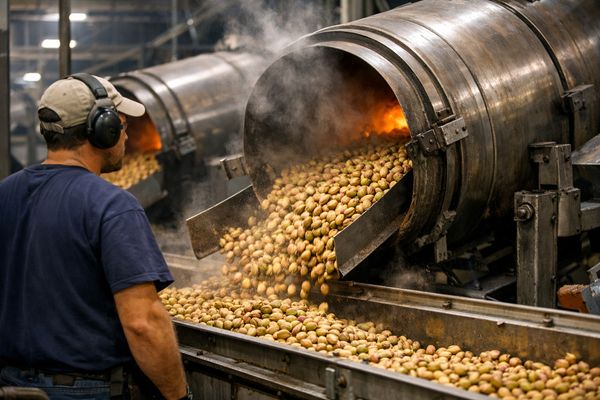
Global pistachio prices have surged to multi‑year highs as conflict in the Middle East disrupts Iranian exports and tightens international supply, with benchmark values around $4.57/lb (≈€9.40/kg) and further upside risk if logistics do not normalize. The squeeze is most acute for industrial users in confectionery and premium sweets, where substitution away from pistachios is limited and cost pass‑through increasingly likely.
Pistachio flows from Iran – accounting for nearly 20% of global production and roughly one‑third of world exports – have been heavily disrupted by shipping suspensions and rerouted trade, particularly since early March. Freight suspensions to key hubs such as the UAE and constraints around the Strait of Hormuz have amplified an already tight fundamental backdrop of firm demand and concentrated supply. Food processors, especially in the Middle East and Europe, are now competing more aggressively for alternative origins and remaining stocks, driving further price volatility.
Exclusive Offers on CMBroker

Pistachio inshell
Ahmadaghaei, 24-26
FOB 9.50 €/kg
(from IR)

Pistachio inshell
Ahmadaghaei, 28-30
FOB 9.26 €/kg
(from IR)

Pistachio inshell
Ahmadaghaei, closed mouth, 24-26
FOB 7.01 €/kg
(from IR)
📈 Prices & Market Mood
Pistachio prices have jumped sharply in recent weeks, with global benchmarks reported around $4.57 per pound, the highest level since 2018, reflecting both physical scarcity and elevated geopolitical risk.
This level translates to roughly €9.40/kg at current FX rates and is broadly consistent with recent Iranian FOB offers for in‑shell pistachios, such as Ahmadaghaei 24–26 at about €9.50/kg and 28–30 at about €9.26/kg, indicating that spot and forward markets are aligned around a high‑price regime.
The tone is clearly bullish: buyers are front‑loading purchases where logistics allow, while sellers in less affected origins are testing higher offers as they sense stronger bargaining power.
| Product | Origin | Delivery | Latest Indication (EUR/kg) |
|---|---|---|---|
| Pistachio inshell, Ahmadaghaei 24–26 | Iran | FOB Tehran | €9.50 |
| Pistachio inshell, Ahmadaghaei 28–30 | Iran | FOB Tehran | €9.26 |
| Pistachio inshell, Ahmadaghaei closed mouth 24–26 | Iran | FOB Tehran | €7.01 |
🌍 Supply & Demand Balance
Iran’s role is pivotal: it provides close to one‑fifth of global pistachio production and around one‑third of exports, so any disruption quickly reverberates through destination markets.
The escalation of conflict and related shipping restrictions since early March have led major carriers to suspend or curtail cargoes to Middle Eastern transshipment hubs such as the UAE, sharply reducing the effective availability of Iranian product in global trade flows.
This comes on top of already concentrated production in a handful of origins (notably the US, Iran and Türkiye), limiting the system’s ability to quickly replace lost Iranian volumes.
Demand, meanwhile, remains resilient.
Industrial usage in confectionery, ice cream and premium chocolate – including fast‑growing hubs like Dubai – shows limited elasticity in the short term, as pistachios are core to product identity and branding.
While some manufacturers are exploring partial switches to almonds, hazelnuts or peanuts, experts stress that pistachios’ distinctive flavour, texture and visual appeal make full substitution difficult, especially in high‑end applications; this inelasticity is helping to lock in higher prices.
📊 Logistics, Trade Routes & Fundamentals
The key short‑term driver is logistics, not orchard output.
Conflict‑related disruption around the Strait of Hormuz and wider Middle East shipping lanes has increased transit times, freight rates and insurance costs for cargoes originating in or transiting via Iran, with some liners cancelling bookings altogether.
Since 2 March, suspensions to Middle Eastern hubs have effectively throttled Iran’s export channels, forcing traders to seek alternative ports or overland routes with limited capacity and higher costs.
External reports over the last two days confirm that these disruptions have pushed pistachio prices to an eight‑year high and left downstream users, particularly in Dubai’s chocolate sector, scrambling for supply.
Fundamentally, the global balance was already tight.
Recent industry data show that world pistachio consumption continues to grow, while production in major origins has been constrained in recent seasons by weather and water challenges, particularly in the US and Iran.
Stocks in some European and UK warehouses offer a short‑term buffer, but these inventories are finite and may not be easily replenished if Iranian exports remain disrupted into the second half of 2026.
This combination of constrained logistics, concentrated supply, firm end‑use demand and limited stocks underpins the current high price environment.
🌦️ Weather & Crop Outlook
While the immediate price spike is driven by geopolitics and shipping, weather remains an important medium‑term risk factor.
Key producing regions in Iran, the US (California) and Türkiye are entering critical stages for nut set and early development; after several years of drought‑related stress, orchards remain sensitive to heat and water availability.
Any additional weather shock later in 2026 could tighten the balance further, especially if export channels are still impaired, turning what is currently a logistics‑driven spike into a more structural price plateau.
📆 Short‑Term Outlook & Trading Ideas
Given the scale of disruption to Iran’s exports and the lack of near‑term diplomatic resolution, the base case for the next few weeks is continued tightness and elevated prices.
Price action is likely to remain headline‑driven, with any signs of de‑escalation or restoration of normal shipping through regional hubs triggering brief corrections, while renewed military incidents or further sanctions could prompt additional spikes.
Industrial buyers, particularly in Europe and the Middle East, face increasing margin pressure as their ability to reformulate away from pistachios is structurally limited.
- For industrial buyers: Consider bringing forward coverage for Q2–Q3 needs where logistics allow, focusing on diversified origins and supplier bases rather than price optimisation alone.
- For traders: Maintain a cautiously bullish bias but manage geopolitical risk with tight position limits; basis and freight spreads may offer more attractive opportunities than outright price exposure.
- For retailers & brands: Prepare for necessary price adjustments or pack‑size changes in pistachio‑intensive product lines, and communicate clearly about supply‑driven cost pressures.
📌 3‑Day Directional View (EUR Terms)
- FOB Iran (Tehran, in‑shell): Sideways to slightly firmer in EUR as physical trade is constrained but sentiment remains nervous; offers around €9.3–9.6/kg are likely to hold.
- CIF Middle East hubs: Firm to higher, with freight and insurance premia keeping landed prices above origin levels and vulnerable to further spikes.
- CIF EU ports: Mild upward bias as buyers compete for non‑Iranian origins and remaining Iranian stocks; any easing in freight bottlenecks would first show up here as stabilisation rather than a sharp drop.
Related posts:
 South Africa’s Pistachio Gamble: New Supply in a Tight Global Market
 Pistachio Kernels Tighten as Shipments Outpace Supply
 Iranian Pistachio Gap Keeps Europe Tight Despite Diplomatic Hopes
 War-Driven Supply Shock Pushes Pistachios to Eight-Year Highs
 Spain Opens Door to China: What the New Pistachio Protocol Means for Prices
 Walnuts: Export Boom Meets Middle East Bottleneck
 India’s NAAS Pushes One-Time Licensing for Imported Horticulture Varieties, Targeting Lower Seed Costs and Stronger Export Competitiveness
 Iran Conflict Pushes Pistachios to 8‑Year High as Supply Squeeze Deepens