
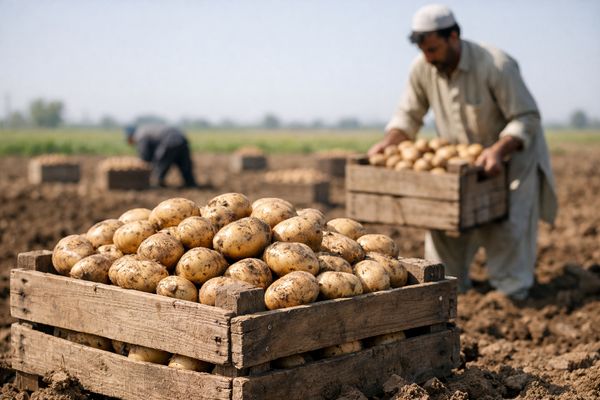
Pakistan’s potato market is entering a high‑surplus phase, with exports recovering on the back of a reopened Russian market but domestic downside price risk still dominant.
Pakistan’s 2025‑26 potato season is defined by a sharp production jump, only partially offset by export growth. With 248,000 tonnes shipped by January and a surplus estimated at 4–4.5 million tonnes, the sector urgently needs additional outlets to avoid a domestic price slide. Russia’s phytosanitary reopening from April 8 and stable Gulf demand provide a crucial release valve, but the speed of Russian exporter approvals and regional competition from Egypt and Europe will determine how much of the surplus can be cleared in the next 3–9 months.
Exclusive Offers on CMBroker

Potato starch
powder
FCA 0.85 €/kg
(from PL)
📈 Prices & Current Market Tone
Domestic fresh-potato prices in Pakistan are under structural downward pressure as the market digests a harvest rising from 8.7 to roughly 12 million tonnes year-on-year. The export pace to date (248,000 tonnes, July–January) is solid but still far below the country’s typical 500,000–600,000 tonne annual export potential, leaving large volumes in local channels. In Europe, derivative products such as Polish potato starch have traded broadly sideways since early April around EUR 0.85/kg FCA Lodz, signalling neither acute tightness nor severe oversupply in starch markets and offering limited support to raw-potato values.
🌍 Supply & Demand Balance
Supply is the dominant driver. The 2025‑26 crop near 12 million tonnes versus 8.7 million tonnes a year earlier creates an exceptional surplus of 4–4.5 million tonnes, far above Pakistan’s usual export absorption capacity. This surplus amplifies dependence on external markets and heightens the risk of storage congestion and quality losses if export logistics lag the harvest and warehouse inflows.
On the demand side, Gulf buyers (UAE, Qatar, Oman) and Sri Lanka continue to provide a stable pull, while Afghanistan absorbed about 29,400 tonnes in the first half of the fiscal year and smaller African destinations such as Somalia signal early diversification. However, even optimistic export growth from these existing customers is unlikely to clear the entire surplus without a substantial and sustained Russian demand window.
📊 Trade Flows & Policy Drivers
The reopening of Russia’s market following the removal of phytosanitary restrictions on Punjab-origin potatoes is the key structural shift. From April 8, three Pakistani companies received approval to ship to Russia, with roughly 40 additional firms submitted for registration. This staged certification process reflects standard Russian plant‑health protocols but also acts as a practical cap on near‑term export volumes until more exporters are cleared.
Pakistan exported about 248,000 tonnes of potatoes between July 2025 and January 2026, generating roughly USD 56 million in export earnings, led by the UAE, Sri Lanka and Afghanistan. Parliamentary scrutiny via the Standing Committee on National Food Security and Research has pushed for new trade routes and market openings, but so far without concrete support measures such as export incentives, logistics subsidies or strategic stock programs, leaving the market heavily reliant on private‑sector execution.
🌦️ Weather & Regional Signals
The latest outlook from Pakistan’s meteorological authorities points to above‑normal rainfall and above‑normal temperatures for May 2026 across much of the country, with especially wet conditions in northern Punjab and Khyber Pakhtunkhwa and somewhat milder anomalies in Sindh and southern Punjab. For potatoes already harvested and in storage, this pattern primarily raises concerns around humidity, infrastructure stress and potential logistical disruptions, rather than yield impacts for the current crop.
Internationally, short‑term potato price behavior in Indian mandis is mixed, with very wide intraday ranges—equivalent to roughly EUR 0.33–1.96 per 100 kg in parts of Madhya Pradesh and Rajasthan—reflecting localized surpluses and tight spots. This volatility underscores that South Asian buyers are highly price‑sensitive and opportunistic; Pakistani exporters may face aggressive competition from Indian and Egyptian origin in overlapping markets, especially where logistics advantages narrow delivered‑cost gaps.
📆 Outlook & Price Implications
Over the next 30–90 days, the critical variable is the pace at which the list of Russian‑approved Pakistani exporters expands. If most of the roughly 40 pending firms secure approval by mid‑summer, Russia could absorb a meaningful share of Pakistan’s 4–4.5 million tonne surplus, easing pressure on domestic prices and freeing storage capacity. Slow approvals, by contrast, would trap more volume in domestic and regional markets, intensifying price weakness, particularly for non‑export‑grade stocks.
Over 6–12 months, the sector’s trajectory will hinge on three levers: durable Russian demand (potentially supported by Russia’s broader pivot towards Asian suppliers), continued Gulf and South Asian buying, and Pakistan’s success in building new African and CIS channels. Without such diversification, domestic prices are likely to remain subdued across much of the 2025‑26 fiscal year despite any localized export spikes.
💡 Trading & Procurement Strategy
- Pakistani growers & traders: Prioritize contracts with exporters targeting Russia and premium Gulf buyers while actively managing storage risk; where feasible, forward‑fix export‑linked volumes before any further weakening in local cash prices as surplus pressure builds.
- Importers in Russia and the Gulf: Use Pakistan’s surplus to secure favorable EUR‑denominated prices and diversify away from higher‑cost European origins, but build in quality and phytosanitary clauses given rapid volume scaling and variable handling standards.
- Processors & starch buyers in Europe: With potato starch offers in Poland stable around EUR 0.85/kg FCA, short‑term supply risk appears limited; consider staggered coverage rather than front‑loading purchases, while monitoring any indirect impact from stronger fresh export demand on raw‑material costs.
- Policy and logistics stakeholders: Fast‑track Russian certification, streamline border procedures for regional trade, and explore temporary freight or storage support to prevent distress sales that could destabilize farm incomes.
📍 3‑Day Directional Price View (EUR)
| Market | Product | Direction (3 days) | Comment |
|---|---|---|---|
| Pakistan domestic wholesale | Fresh potatoes | ⬇ to ⬇⬇ | High surplus and limited immediate new export capacity point to continued soft to weaker prices in EUR terms. |
| Gulf import markets | Pakistani table potatoes (CIF) | ➡ to ⬇ | Well‑supplied region; buyers hold negotiating leverage, with modest downside in offer levels likely. |
| Poland (Lodz) | Potato starch FCA | ➡ | Recent weeks show a flat trend around EUR 0.85/kg; no near‑term catalyst for sharp moves identified. |
Related posts:
 Dutch Seed Potato Market Correction Puts Pressure on Growers but Not a Crisis
 Brazil potato prices surge as harvest gap tightens supply
 Indian Onion Market Under Pressure as Rabi Glut Meets Export Slump
 European Potato Market: Dry Start to Season Keeps Prices Supported
 Polish Potato Sector at a Turning Point: Surplus Pain, Quality Risks, Starch Support
 Potato Markets Under Pressure: Why Post‑Harvest Value Now Matters Most
 San Luis Valley Potato Surplus Puts Structural Pressures in Focus