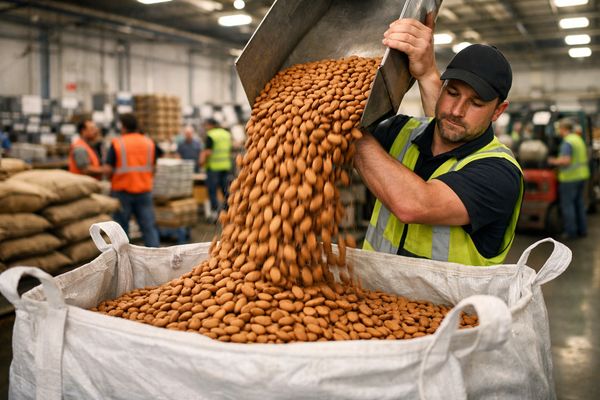
Almond kernel prices in both Spain and the US are broadly stable at the start of May, with only marginal week‑on‑week movement and no clear directional break. Comfortable global supply and seasonally supportive weather in key growing regions are keeping volatility low in the short term.
The almond market enters May with a sideways tone. Spanish FOB Madrid prices for key Marcona and Valencia grades are unchanged from late April, while US FAS/FOB offers for standard and organic Nonpareil and Carmel from Washington D.C. are also flat in euro terms. Recent industry data point to steady California acreage and adequate global supply, while early‑season weather in both California’s Central Valley and the main Spanish Mediterranean growing belt is generally mild and non‑disruptive. With no fresh shocks on the macro or demand side over the last few days, traders are focusing on nearby shipment programs and FX rather than repricing fundamentals in a major way.
Exclusive Offers on CMBroker

Almonds kernels
carmel, ssr, 18/20
FAS 6.65 €/kg
(from US)

Almonds kernels
natural, 27/30, nonpareil ssr
FOB 9.27 €/kg
(from US)

Almonds kernels
carmel, ssr 20/22
FAS 6.60 €/kg
(from US)
📈 Prices & Spreads
Using an indicative EUR/USD of 0.93, current kernel offers translate into the following ranges:
| Origin / Grade | Location / Term | Latest Price (EUR/kg) | WoW Change (EUR/kg) |
|---|---|---|---|
| US Carmel SSR 18/20 | Washington D.C., FAS | ≈ 6.18 | 0.00 (stable) |
| US Carmel SSR 20/22 | Washington D.C., FAS | ≈ 6.14 | 0.00 (stable) |
| US Nonpareil 27/30, organic | Washington D.C., FOB | ≈ 8.62 | 0.00 (stable) |
| ES Marcona 14/16 | Madrid, FOB | 8.15 | 0.00 (stable) |
| ES Marcona 12/14 | Madrid, FOB | 6.55 | 0.00 (stable) |
| ES Valencia 10/12 | Madrid, FOB | 5.55 | 0.00 (stable) |
| ES Guara S/14 | Madrid, FOB | 6.05 | 0.00 (stable) |
| ES Nonpareil 27/30, organic | Madrid, FOB | 11.40 | 0.00 (stable) |
- Spanish conventional Valencia‑type kernels are trading at a discount of roughly EUR 0.30–0.60/kg to comparable US standard grades, while premium Marcona and organic lines still command a sizeable premium.
- Price curves over April show only very small week‑to‑week adjustments (mostly EUR 0.05/kg steps), confirming a broadly flat market.
🌍 Supply & Demand Drivers
Global almond supply remains comfortable. Recent international nut industry data show the USA, Spain and Australia together providing the bulk of 2025/26 world supply, with US beginning stocks still sizeable and Spanish production structurally higher than a few years ago. California acreage is projected to be broadly steady through 2026 rather than expanding aggressively, reducing the risk of another large oversupply wave but still implying ample availability under normal yields.
Demand indicators from major importing regions (EU, Middle East, Asia) have not shown any abrupt change over the past few days, and recent commentary points to reasonably good export flows out of California and solid absorption of Spanish kernels within Europe. With no major logistical disruptions reported this week, nearby trading is largely shipment‑ and customer‑program driven, rather than speculative.
☀️ Weather & Crop Outlook (US & Spain)
For California’s Central Valley, which concentrates most US almond orchards, short‑term forecasts around May 2–5 show mild temperatures (roughly 17–25°C highs) with some cooler, cloudier intervals but no extreme heat, frost or prolonged rain events. Bloom is already past, and this kind of pattern is considered neutral to slightly positive for nut set and early kernel development.
In Spain, Mediterranean coastal areas such as the Valencian community are forecast to remain mostly dry or with only light, scattered showers over the coming 3–5 days, with daytime highs in the low 20s °C. Broader forecasts for early May call for some rain in the northwest and more variable conditions inland, but generally mild and seasonally typical weather across key almond regions, with stability along much of the Mediterranean belt. Overall, near‑term weather does not introduce a clear bullish or bearish shock for yields in either the US or Spain.
📊 Fundamentals & Market Tone
- Stocks and acreage: US beginning stocks remain elevated, and California almond planted area is expected to be essentially flat through 2026, tempering long‑term oversupply concerns without removing current availability.
- Policy and water: New and forthcoming groundwater limits in California, highlighted recently by market analysts, are increasing longer‑term cost and production uncertainty, but these are gradual, structural issues rather than near‑term price triggers.
- Spain & Europe: Spain’s output has expanded in recent seasons, and while some parts of eastern Spain still monitor moisture deficits, current conditions in April–May are not yet pointing to a sharply reduced 2026 crop.
- Speculative interest: Broader ag markets have seen muted fresh news and limited new speculative positioning around May 1, reinforcing the sideways tone in nuts as well.
📆 Trading Outlook & 3‑Day Price View
Trading recommendations (short term)
- Buyers (roasters, processors, retailers): Use the current stability to cover Q2–Q3 needs on a rolling basis, prioritising Spanish Valencia and Guara for cost‑effective coverage and locking in small volumes of Marcona and organic Nonpareil where specific qualities are required.
- Growers and handlers (ES & US): With no immediate weather threat and comfortable stocks, avoid aggressive discounting on standard grades; instead, use selective offers on smaller sizes or off‑grades to maintain pipeline movement without undermining the flat price structure.
- Traders: Market remains range‑bound; focus on origin arbitrage (Spain vs US) and FX moves rather than directional bets over the next couple of weeks.
3‑day directional outlook (EUR, spot/nearby)
- Spain (FOB Madrid, main grades): Prices expected to remain flat over the next 3 days, with only minor intra‑day offers possible on specific sizes/qualities; no weather‑driven premium seen.
- US (FAS/FOB Washington D.C., export‑oriented grades): Sideways bias in euro terms, with small day‑to‑day moves more likely from FX than from fundamentals; no clear catalyst for a breakout by mid‑week.