
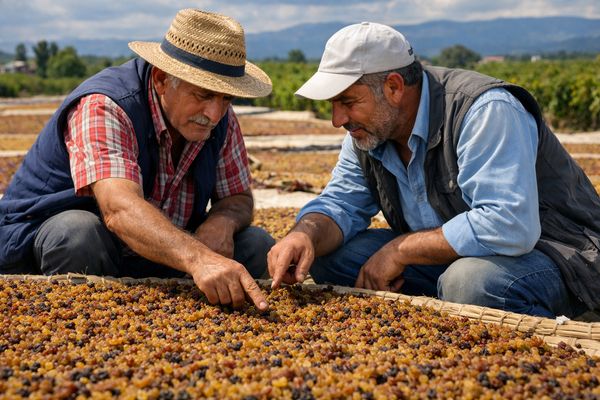
Turkish raisin prices are under pressure, but physical availability is increasingly tight as farmers refuse to sell at current raw material levels and weather risks cloud the new crop outlook.
The market is caught between falling raw material prices and farmer resistance. In Turkey’s key sultana regions, growers face offers of 85–90 TL/kg for raw grapes and are selling only minimal volumes, hoping for better levels toward June when the harvest outlook becomes clearer. At the same time, recent and upcoming heavy rainfall and patchy frost around Manisa add weather risk to the 2026/27 crop, limiting downside in export prices despite the current dispute. Demand from rakı producers has not yet materialised, further delaying a price floor.
Exclusive Offers on CMBroker

Raisins
sultanas, type 9, grade A, organic
FOB 3.10 €/kg
(from TR)

Raisins
sultanas, type 9, rtu grade STD
FCA 2.17 €/kg
(from DE)

Raisins
sultanas, type 10, grade A
FOB 2.34 €/kg
(from TR)
📈 Prices & Market Structure
Exporter–farmer price disputes dominate the current Turkish raisin market. Raw material has been pushed down to about 85–90 TL/kg, but growers are largely unwilling to sell at these levels and instead release only cash‑need volumes. This farmer holding behaviour contrasts with softening export quotations, where several Turkish sultana types have eased by roughly 10–20% since mid‑April in EUR terms.
Indicative export prices on 22 April show conventional Turkish sultanas type 9–10 in the range of about EUR 2.15–2.35/kg FOB, with organic type 9 around EUR 3.10/kg. Competing origins are broadly stable: Chinese sultanas around EUR 2.10–2.20/kg FCA North Europe and Indian raisins mostly between EUR 1.75–2.30/kg FOB, depending on type and colour. Overall, the global market is well supplied, but Turkish internal tensions are creating local volatility.
| Origin / Type | Location & Terms | Latest Price (EUR/kg) | WoW Direction* |
|---|---|---|---|
| TR sultanas type 9, conv. | Malatya, FOB | ≈ 2.18 | ▼ (from 2.55) |
| TR sultanas type 10, conv. | Malatya, FOB | ≈ 2.34 | ▼ (from 2.85) |
| TR sultanas type 9, organic | Malatya, FOB | ≈ 3.10 | ➡ |
| CN sultanas no. 9, std | Dordrecht/Hamburg, FCA | ≈ 2.12–2.17 | ➡ |
| IN raisins (golden/brown/black) | New Delhi, FOB | ≈ 1.75–2.27 | mix |
*Direction based on changes during April in EUR terms.
🌍 Supply, Demand & Farmer Behaviour
On the supply side, the key feature is not physical shortage but withheld stock. Farmers in the main Turkish sultana areas are deliberately restricting sales, dissatisfied with 85–90 TL/kg raw material prices and confident that tighter availability and weather uncertainty will support higher levels later. Only producers with immediate liquidity needs are accepting current bids, keeping spot flows thin and underpinning interior prices despite exporter pressure.
Demand remains seasonally moderate. A crucial missing piece is purchasing from rakı producers, who have not yet entered the market. Their delayed buying keeps an important demand channel closed and contributes to today’s weak raw material prices. Once these industrial users return, competition for raw grapes is likely to intensify, strengthening the farmers’ negotiating position and potentially lifting both raw and processed raisin prices.
🌦️ Weather & New Crop Outlook
For the new season, vineyards have already experienced excessive rainfall and partial frost damage. Current assessments suggest losses are less severe than last year, but the real impact on yield and quality remains uncertain. Heavy rains are again expected for two days this week in and around Manisa, reinforcing concerns about disease pressure and berry quality as flowering and early vegetative stages progress.
Weather forecasts for Manisa show significant rain and drizzle on 22–23 April, followed by a return to sunnier, warmer conditions from 24 April onward, which should support vine recovery if no further frost events occur. The harvest period from mid‑May to early June will be decisive: field surveys at that point will give a clearer view of actual crop size and quality distribution. Until then, uncertainty over the 2026/27 crop will act as a risk premium, limiting further downside in export offers.
📊 Fundamentals & Risk Balance
Fundamentally, the global raisin balance still looks comfortable thanks to adequate supplies from Turkey, China, India and South America. However, Turkish sultanas remain a benchmark for many European buyers, and internal tensions in Turkey can quickly transmit into CIF prices for key consuming markets. The combination of farmer stockholding, delayed rakı buying and weather risk creates a classic stand‑off: exporters push prices lower to secure competitiveness, while growers bet on future tightness.
If weather normalises and damage indeed stays below last year’s levels, the medium‑term balance would lean bearish, especially if other origins maintain or increase export availability. Conversely, any escalation of frost or prolonged rainfall during sensitive growth stages could flip sentiment and trigger a sharp rebound in Turkish offer prices, as exporters rush to secure limited high‑quality raw material.
📆 Short-Term Outlook & Trading Ideas
- Direction (next 2–4 weeks): Sideways to slightly firmer in EUR terms for Turkish sultanas, as farmer resistance and weather risk offset weak immediate demand.
- For importers/packers: Consider covering near‑term needs now in standard grades, using current weakness, but keep some volume open for Q3 in case of further crop‑related price adjustments.
- For exporters in Turkey: Be cautious about over‑committing at today’s low raw material levels; a modest risk premium for weather and farmer resistance seems justified in new offers.
- For farmers: The strategy of selling only cash‑need volumes appears supported by fundamentals, but monitor June field assessments closely to avoid missing potential rally windows.
📍 3‑Day Regional Price Indication (Directional)
- Turkey, FOB Malatya (sultanas type 9–10): Stable to slightly firmer in EUR; downside limited by farmer holding.
- Northwest Europe, FCA (Chinese/Turkish sultanas): Mostly stable in EUR; minor adjustments tracking Turkish sentiment and FX.
- India, FOB New Delhi (golden/brown/black): Broadly stable in EUR, acting as a competitive floor against sharper Turkish increases.
Related posts:
 Tight Stocks, Weather Risks: Turkish Dried Apricots Hold Firm at High Levels
 Raisin Prices Hold Firm as India Faces Heatwave and Turkey Watches the Skies
 Indian Raisin Prices Firm on Tight Supply and Hot, Dry Weather
 Raisin prices hold firm as Indian supply recovers and premium grades stay tight
 Frost Damage Threatens Orchards and Vineyards, Lifting Price Risk Across Fruit and Raisin Markets
 Raisin Prices Ease Slightly as Turkish Offers Hold Flat and India Softens