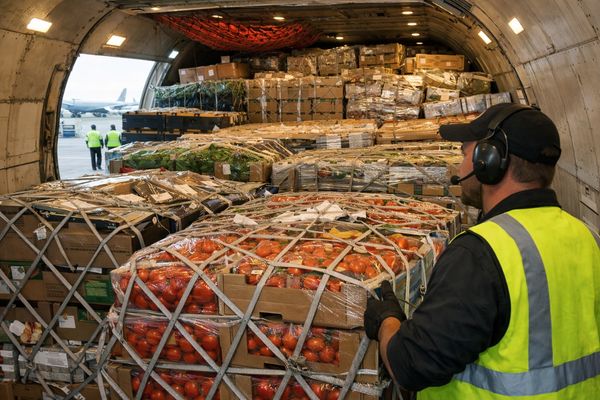
Europe Retail Packing’s fresh division, ERP Produce, has overhauled its sourcing model in response to escalating supply chain disruption linked to the Middle East conflict, tightening airfreight capacity and petrochemical supply into Europe. The company, which supplies herbs, capsicums and greenhouse vegetables to European retailers and wholesalers, is shifting volumes toward European and African origins while warning of at least four to six months of continued market instability. Rising freight and packaging costs, alongside emerging fertiliser risks, are set to ripple through agricultural commodity markets and food value chains.
The restructuring comes as air cargo capacity on Gulf-linked corridors has fallen sharply due to the war in the Middle East and airspace restrictions, even as some alternative Asia–Europe and Africa–Asia lanes grow. Recent IATA data for March show Europe–Middle East air cargo traffic down more than 50%, highlighting the scale of disruption to transit hubs that traditionally serve perishables moving into Europe. At the same time, the World Bank’s latest Commodity Markets Outlook warns that the conflict is driving a 24% surge in energy prices this year, with knock-on effects on fertiliser and petrochemical-derived inputs used for packaging.
🌍 Immediate Market Impact
ERP Produce reports immediate, broad-based disruption across airfreight and upstream materials. Airline capacity on key Middle Eastern routes has contracted while freight rates have risen sharply, in line with wider market indicators showing tightening air cargo supply and war-risk surcharges on Middle East–linked trade lanes. This is particularly acute for high-value, time-sensitive fresh products such as herbs and greenhouse vegetables that rely on fast transit.
At the same time, shortages of petrochemical-based raw materials sourced from the Persian Gulf are driving up costs for packaging items such as plastics, liners and cardboard. Global analysis indicates that oil and petrochemical disruptions in the Gulf are pushing up prices for polymers and packaging-grade resins in Europe, with spot polyethylene prices reportedly up by 70–80% between February and April 2026. For ERP Produce and comparable operators, these factors combine into higher landed costs, reduced supply flexibility and greater price volatility for fresh produce programs.
📦 Supply Chain Disruptions
The tightness in airfreight is producing both cost inflation and routing complexity. Logistics providers report that Middle East air and sea corridors are subject to restrictions, diversions and additional risk premiums, with some carriers cancelling flights to key Gulf destinations and redirecting capacity. For European produce buyers, this raises the risk of delayed or cancelled shipments from non-European origins, especially for products that cannot easily shift to slower ocean transport.
ERP Produce indicates that order backlogs are building and availability is tightening at multiple stages of the chain, from sourcing and packing to outbound distribution. In addition, broad cost escalation in transport, storage and packaging is squeezing smaller operators that lack the balance-sheet capacity to absorb shocks. While Europe currently has strong local supply of herbs and greenhouse vegetables, subdued consumer demand and periodic oversupply risk abrupt swings in harvest volumes and temporary shortages if fields are under-harvested during weak demand periods.
Beyond fresh produce, fertiliser availability is emerging as a structural risk. Research on potential Strait of Hormuz disruption scenarios suggests that under contested or extended conflict, benchmark phosphate fertiliser prices (DAP) could climb 40–50% above pre-crisis levels, with a slow path back to normalised pricing. Such price spikes would feed directly into growers’ cost structures for vegetables and herbs in Europe and Africa.
📊 Commodities Potentially Affected
- Fresh herbs (basil, coriander, mint) – High reliance on fast airfreight from Mediterranean, Middle Eastern and African origins makes them vulnerable to capacity cuts and higher rates, raising delivered costs into EU retail programs.
- Capsicums and greenhouse vegetables – Intensive input use (energy, fertiliser, packaging) and frequent cross-border trucking and airfreight exposure create sensitivity to both fuel and logistics price shocks.
- Plastic-based packaging (films, punnets, liners) – Petrochemical disruption in the Gulf and higher oil prices are lifting polymer costs and tightening availability for packaging converters in Europe.
- Fertilisers (urea, DAP, NPK blends) – Gulf production and shipping constraints, combined with conflict-related risk around Hormuz, are driving scenarios of sharply higher prices and intermittent supply for major importers.
- Sea- and air-freighted fruit & vegetables from the Middle East – Route closures, port congestion and elevated insurance costs are adding time and expense, eroding competitiveness versus European or African origins.
🌎 Regional Trade Implications
ERP Produce’s strategy centres on increasing volumes from Spain, Germany and Italy, supplemented by established Dutch growers and continued but recalibrated sourcing from Kenya and Ethiopia. This multi-origin approach aims to reduce dependence on any single corridor exposed to Middle Eastern airspace or Hormuz-related risks. In practice, it shifts marginal demand toward intra-European and Africa–Europe trade routes that are currently seeing more stable capacity and, in some cases, modest volume growth.
European greenhouse clusters benefit from this reorientation through higher program volumes and potentially firmer forward pricing, especially if logistics from the Gulf remain volatile. African exporters with reliable uplift via alternative hubs may also gain share, provided they can secure airfreight capacity not tied to disrupted Gulf nodes. Conversely, growers and packers in Middle Eastern production basins that previously served Europe face weaker demand and more challenging access to EU markets, reflecting both logistical risk and rising war-related costs.
In fertilisers and petrochemicals, the Gulf’s role as a core production and export hub means that sustained disruptions will prompt more aggressive sourcing from alternative regions, including North Africa, Russia and North America. However, recent modelling suggests that such substitution may only partially offset Gulf shortfalls, keeping price levels elevated for import-dependent regions such as Asia and parts of Europe.
🧭 Market Outlook
ERP Produce’s expectation of at least four to six months of disruption aligns with broader freight market assessments pointing to constrained air cargo capacity and heightened routing risk across the Middle East through mid-2026. Over the near term, traders should anticipate persistent war-risk surcharges, elevated airfreight yields and occasional port or corridor-specific congestion events affecting perishables.
On the cost side, the World Bank projects that energy and fertiliser prices will remain significantly above pre-conflict levels this year, with oil, gas and fertiliser markets all exhibiting higher volatility in geopolitical stress periods. If petrochemical feedstock shortages persist due to damaged Gulf infrastructure and export constraints, pressure on packaging and agrochemical input prices is likely to extend into the 2026–27 growing seasons.
For fresh produce markets, the current combination of strong European supply and subdued demand is temporarily cushioning end-consumer prices. However, delayed investment, margin compression among smaller packers and the potential for under-application of fertiliser could set the stage for tighter supply and firmer prices from 2027 onward, especially if fertiliser affordability deteriorates further.
CMB Market Insight
ERP Produce’s sourcing shift illustrates how the Middle East conflict is accelerating a structural rebalancing of European fresh produce supply chains away from Gulf-centric airfreight and petrochemical corridors. For commodity market participants, the key signals are sustained air cargo tightness on Europe–Middle East lanes, elevated energy and fertiliser benchmarks, and rising prices for petrochemical-derived packaging materials.
In the coming months, traders and procurement teams should closely monitor freight rate indices for Middle East-linked air and sea routes, fertiliser price curves under various Hormuz disruption scenarios, and polymer pricing in European spot markets. A diversified origin strategy and early-season contracting for logistics, packaging and fertiliser will be critical to managing both availability risk and margin volatility across the fresh produce value chain.