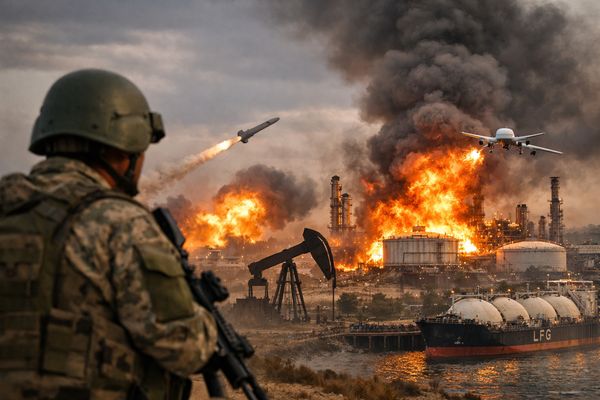
Intensifying conflict in the Middle East and stepped-up Ukrainian drone attacks on Russian oil infrastructure are converging to tighten global energy markets, with Brent crude trading well above USD 110 per barrel and logistics risks elevated around key export hubs. These developments are feeding through to refined products and LPG pricing, with traders and downstream users bracing for higher costs and greater volatility into May.
For agricultural and food supply chains, the combination of higher bunker and fuel prices, longer tanker routes, and mounting risk premia on shipments through exposed corridors is set to raise logistics costs, particularly for import-dependent markets in Asia, Africa, and Europe.
Headline
Iran War and Ukrainian Drone Strikes on Russian Oil Sites Deepen Fuel Shock, Raising Costs Across Agri-Food Supply Chains
Introduction
The 2026 Iran war has triggered a severe disruption in global oil flows after the U.S.–Israel coalition’s campaign and Iran’s moves around the Strait of Hormuz, a chokepoint that previously handled about one‑fifth of global oil trade and a similar share of LNG volumes. Recent analysis points to sharply reduced tanker traffic and persistent supply risk, even as limited reopenings are negotiated.
In parallel, Ukraine has intensified long‑range drone attacks on Russian oil facilities and export terminals, hitting refineries and storage sites at Tuapse on the Black Sea and deeper inside Russia in regions such as Perm and Orenburg. These strikes have cut into Russian refining capacity and disrupted export logistics at a time when global markets are already tight due to Middle East disruptions.
🌍 Immediate Market Impact
Oil benchmarks have surged to their highest levels since the onset of the Iran war, with Brent recently trading around USD 110–115 per barrel as traders price in sustained outages from the Gulf and higher geopolitical risk premia. Elevated crude prices are pushing up costs for gasoline, diesel, marine fuels and LPG, directly impacting freight, farm operations and food processing.
Closure and partial reopening of Hormuz, combined with redirection of Gulf exports via longer routes and alternative terminals, are elongating voyage times and tightening tanker availability. Simultaneously, damage to Russian export and refining infrastructure on the Black Sea and Baltic is constraining flows of fuel oil, diesel and LPG to Europe, North Africa and parts of Asia, increasing reliance on alternative suppliers and spot cargoes.
📦 Supply Chain Disruptions
Energy and fuel logistics are under strain along several axes. In the Gulf, disrupted Hormuz traffic and security concerns have led to a sharp drop in tanker transits and sporadic congestion as vessels queue or divert to safer lanes. Some producers are exploring rerouting via the Red Sea or internal pipelines, but capacity constraints limit the scale and speed of adjustment, especially for LPG and condensates.
On the Russia–Ukraine axis, repeated strikes on facilities such as the Tuapse refinery and other Rosneft-linked assets have damaged storage tanks, loading equipment and associated transport infrastructure, temporarily curbing export capability for refined products. Market assessments indicate that Ukrainian attacks have sidelined a significant portion of Russia’s refining capacity since early 2024 and periodically disrupted up to tens of percent of western oil export capacity, creating intermittent shortages of diesel and fuel oil in destination markets.
For agricultural commodities, this translates into higher and more volatile bunker surcharges in freight contracts, risk‑adjusted premiums for shipments transiting exposed sea lanes, and potential delays as operators reroute around conflict zones. Container and bulk carriers serving grain, oilseed, sugar and fertilizer trades must increasingly compete with energy cargoes for vessel space on alternative routes.
📊 Commodities Potentially Affected
- Grains and oilseeds (wheat, corn, soybeans, rapeseed) – Higher bunker fuel and freight rates lift CIF import costs, particularly into North Africa, the Middle East and Asia, while any congestion at Black Sea or Mediterranean hubs could slow exports.
- Rice – Key Asian exporters may face higher shipping costs on longer routes around conflict‑affected waters, raising delivered prices for West Africa and the Middle East.
- Sugar – Brazil, India and Thailand could see higher freight and insurance costs on raw and refined sugar exports, with potential passthrough to global benchmarks.
- Vegetable oils (sunflower oil, palm oil, soybean oil) – Disruptions in Black Sea energy logistics and higher fuel costs affect sunflower oil exports from the region, while elevated freight rates impact palm and soybean oil flows into the Middle East and Europe.
- Fertilizers (urea, ammonia, potash, phosphates) – Energy‑intensive production and dependence on gas‑linked feedstocks make nitrogen fertilizers particularly sensitive to sustained oil and gas price increases, impacting cost structures for farmers globally.
- LPG and propane/butane for cooking and agro‑industry – Gulf and Russian disruptions to LPG production and export channels tighten supply, raising wholesale prices and filtering into costs for food processing, grain drying and hospitality sectors in import‑reliant countries.
🌎 Regional Trade Implications
Importers in Europe, North Africa and the Middle East face a dual exposure: dependence on Russian refined products and LPG, and vulnerability to Gulf supply disruptions and longer tanker routes. As a result, they are increasingly pivoting toward alternative suppliers in the Americas, West Africa and Asia, often at higher freight and premium costs.
Conversely, exporters in the U.S., Brazil and parts of Latin America stand to benefit from stronger demand for both crude and refined products, including marine fuels and LPG, as well as for agricultural commodities whose traditional supply chains via the Black Sea or Gulf become less reliable. However, infrastructure and capacity constraints—ports, pipelines, and tanker availability—limit how quickly these regions can fully offset lost Middle Eastern and Russian flows.
Asian importers, particularly in South and Southeast Asia, may experience intensified competition for spot cargoes of diesel, LPG and fertilizers, with smaller buyers facing the sharpest increases in delivered costs and credit requirements.
🧭 Market Outlook
In the short term, energy and freight markets are likely to remain tight and volatile as the Iran conflict and Ukrainian strikes on Russian oil infrastructure evolve. Traders will closely monitor any further damage to export terminals, refineries or shipping channels, as well as diplomatic moves around Hormuz and the Black Sea that could either ease or exacerbate supply risks.
For agricultural commodity markets, the primary transmission channel is cost inflation rather than immediate physical shortages. Elevated fuel and shipping costs, combined with higher fertilizer prices, could pressure farm margins ahead of upcoming planting and harvesting cycles, supporting price floors for key staples even if crop fundamentals remain adequate.
CMB Market Insight
The intersection of the Iran war’s disruption of Gulf energy flows and Ukraine’s campaign against Russian oil infrastructure marks a structural shock to global fuel logistics that extends well beyond the energy complex. For agricultural and food-sector participants, the environment points to persistently higher cost bases for freight, inputs and processing fuels, with regional disparities driven by proximity to alternative suppliers.
Risk management will be critical: commodity buyers and traders should reassess exposure to conflict‑adjacent routes, consider diversified sourcing and freight strategies, and factor elevated energy‑linked costs into pricing and hedging decisions for the remainder of 2026.