
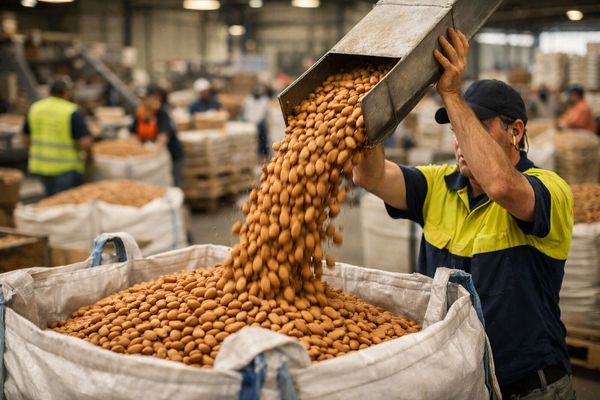
Australia’s almond market enters the new season with one of its best sales years on record behind it, but growing weather and cost risks are setting up a more quality‑driven price environment rather than a pure volume story.
With Australia posting its second‑highest annual almond sales in 2025–26 and export demand from China and India remaining resilient, global buyers face a market where volumes are still ample but high‑quality in‑shell product is tightening. Wet conditions across much of Victoria’s Sunraysia and South Australia’s Riverland are likely to cap the share of top‑grade in‑shell, putting a premium on fruit sourced from the comparatively dry NSW Riverina. At the same time, stable kernel prices in both the US and Spain indicate a market that is firm but not overheated, with input‑cost and logistics risks acting as the main medium‑term upside drivers for quotations.
Exclusive Offers on CMBroker

Almonds kernels
carmel, ssr, 18/20
FAS 6.70 €/kg
(from US)

Almonds kernels
carmel, ssr 20/22
FAS 6.65 €/kg
(from US)

Almonds kernels
natural, 27/30, nonpareil ssr
FOB 9.32 €/kg
(from US)
📈 Prices
Recent export and FOB indications for key origins suggest a broadly stable kernel price environment in early April 2026. US almond kernels (Carmel, SSR, 18/20) are offered around EUR 6.70/kg FAS Washington D.C., with similar grades (Carmel, SSR 20/22) at roughly EUR 6.65/kg. Organic Nonpareil 27/30 from the US trades near EUR 9.30/kg FOB, reflecting the typical organic and variety premium.
Spanish material remains competitive, with Valencia 10/12 kernels offered close to EUR 5.60/kg FOB Madrid and Marcona 12/14 around EUR 6.60/kg. Premium Spanish Marcona S/16 and organic Nonpareil 27/30 are quoted higher, at about EUR 8.85/kg and EUR 11.45/kg respectively. Week‑on‑week and month‑on‑month moves have been marginal, pointing to a sideways to mildly firm price trend, with differentials mainly driven by origin, variety and specification rather than large shifts in overall supply.
🌍 Supply & Demand
Australia closed the 2025–26 marketing season with total almond sales of 154,113 tonnes (kernel weight equivalent), only 9% below the 2024–25 record of 169,363 tonnes and still well above historical averages. A strong final month in February and better‑than‑expected crop realisation offset early worries about crop size, underlining the sector’s resilience and the depth of demand.
Exports remain the backbone of the Australian market, with more than 130,000 tonnes shipped and nearly 70,000 tonnes moving as in‑shell. China and India continued to dominate buying, absorbing the bulk of these export flows. Demand from China was particularly notable, with volumes only around 1% lower than the previous season, while India’s continued appetite for in‑shell almonds helped to stabilise export channels and keep sales close to record levels.
📊 Fundamentals & Weather
The new harvest season is unfolding under challenging weather conditions. Wet weather across nearly three‑quarters of Australian almond‑growing regions, especially in Victoria’s Sunraysia and South Australia’s Riverland, is expected to weigh on crop quality rather than overall availability. Heavy rains raise the risk of staining, disease pressure and higher sorting losses, which in turn reduce the share of top‑grade in‑shell almonds that meet demanding export specifications.
This is already shifting the regional supply picture. The NSW Riverina, which has been relatively dry, is now positioned to supply the bulk of high‑quality in‑shell product. As a result, buyers focused on premium in‑shell for China and India are likely to face a tighter pool of suitable lots, even though aggregate kernel volumes remain comfortable. At the same time, growers are contending with uncertainty over fuel and fertiliser supply, alongside generally rising input costs, factors that could restrain any aggressive expansion plans and support prices through higher cost floors and potentially more conservative production decisions.
📆 Market Outlook
Short term (next 1–3 months): Global demand, particularly from Asian destinations, is expected to remain firm, underpinning export flows from Australia despite quality issues. With overall kernel supply still ample but high‑grade in‑shell tighter, price spreads between standard kernels and premium in‑shell are likely to widen. Spot prices in EUR are seen holding broadly steady to slightly firmer, with individual origins moving more on quality news and logistics than on aggregate volume shifts.
Medium term (rest of 2026): Weather will remain the key swing factor for Australian output and export availability. Continued wet conditions could further pressure quality and raise disease management costs, while any improvement would ease quality concerns but not fully offset the effect of elevated inputs on grower margins. Over time, sustained cost pressure may influence planting and replanting decisions, limiting the pace of acreage growth and setting a more supportive backdrop for prices in both kernels and in‑shell product.
📌 Trading Outlook
- Importers and roasters: Consider forward‑covering a portion of 2026 needs in standard kernels while prices in EUR remain broadly stable, but maintain flexibility on premium in‑shell volumes given expected quality‑linked premiums.
- Industrial users: Differentiate between origins and varieties; Spanish and US kernels currently offer competitive options, but Australian quality spreads could widen, favouring kernels over in‑shell for cost‑sensitive applications.
- Producers and exporters: Prioritise quality management and segregation in wet‑affected regions to capture premiums in China and India, and review pricing to reflect higher fuel and fertiliser costs in negotiations for medium‑term contracts.
📉 3‑Day Price Directional View (EUR)
| Market | Product | Current level (approx.) | 3‑day bias |
|---|---|---|---|
| US (export) | Carmel kernels SSR 18/20 | ~EUR 6.70/kg | Sideways to mildly firm |
| US (export) | Nonpareil organic 27/30 | ~EUR 9.30/kg | Sideways |
| Spain (FOB) | Valencia kernels 10/12 | ~EUR 5.60/kg | Sideways |
| Spain (FOB) | Marcona kernels 12/14 | ~EUR 6.60/kg | Sideways to mildly firm |
Related posts:
 Indian Cashew Kernels Ease as Harvest Peaks, but Freight Risks Limit Downside
 Almonds under seasonal pressure as Indian demand softens
 Walnut Kernels Hold Firm as India Demand Stays Strong and Weather Risks Loom
 Australian Pistachios Gain Ground as Middle East Supply Falters
 Almond Kernels Hold Firm as Weather Risks Loom in Spain and California
 Brazil & India Peanuts Hold Steady as Weather Risks Loom in April
 Almonds stay firm as global supply strains meet cautious demand
 Almond Kernels Hold Firm as Weather Risks Build in US and Spain