
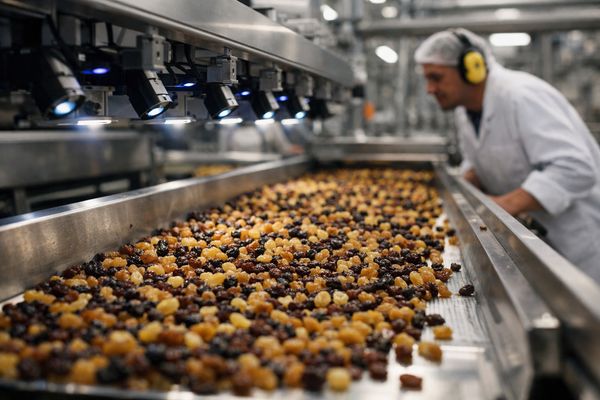
Manisa’s robust export performance and stable stock situation are keeping international raisin prices broadly steady, with only modest intra-origin adjustments. Buyers see no immediate shortage risk but should watch export pace and FX for late-season firmness.
Raisin trade is currently characterized by healthy Turkish flows, comfortable stocks and largely stable EUR prices across major origins. In Manisa, 93,000 tons of raisins have already left the country between 1 September 2025 and 25 April 2026, generating USD 321 million in revenue, while registered stock at end-April stands at about 9,300 tons. Weekly exports of 2,030 tons as of 2 May are only slightly below last year’s level, pointing to solid demand without clear overheating. Weather in Manisa is seasonally mild and dry, supporting vineyards without immediate stress signals. Overall, the market looks balanced in the short term, with a mild upward bias if export momentum remains firm and buyers delay cover.
Exclusive Offers on CMBroker

Raisins
sultanas, type 9, rtu grade STD
FCA 2.17 €/kg
(from DE)

Raisins
sultanas, type 9, grade a
FOB 2.45 €/kg
(from TR)

Raisins
sultanas, type 8, grade A
FOB 2.18 €/kg
(from TR)
📈 Prices
Spot and near-term offers in Europe and origin markets remain broadly unchanged week-on-week. Converting the latest USD-related levels to EUR using an indicative 1.08 EUR/USD rate, most bulk sultanas trade in a band of roughly EUR 2.00–2.70/kg FOB/FCA depending on origin, grade and logistics.
| Origin / Type | Location & Terms | Latest Price (EUR/kg) | 1–2 Week Trend |
|---|---|---|---|
| CN sultanas, no. 9, RTU STD | Hamburg, FCA | ≈ 2.17 | Softly lower vs. late April |
| TR sultanas, type 9, grade A | Malatya, FOB | ≈ 2.45 | Stable after April adjustment |
| TR sultanas, type 10, grade A | Malatya, FOB | ≈ 2.34 | Stable |
| TR sultanas, type 9, organic | Malatya, FOB | ≈ 3.10 | Flat for several weeks |
| TR sultanas, type 9, grade A | Neuenhagen (DE), FCA | ≈ 2.89 | Sharply lower vs. 3.85 prior |
| IN raisins, golden, grade AA | New Delhi, FOB | ≈ 2.26 | Marginally softer |
| IN raisins, brown/black, AA | New Delhi, FOB | ≈ 1.74–1.82 | Slightly easing |
| TR nr. 9, RTU | Dordrecht (NL), FCA | ≈ 2.84 | Sideways |
The notable move is the correction in Turkish sultanas stored in Germany (FCA Neuenhagen and Hamburg), where prices have dropped from around EUR 3.85/kg to roughly EUR 2.89/kg, aligning more closely with FOB levels plus logistics. Indian and Chinese offers show a mild easing, keeping competitive pressure on Turkish suppliers in price-sensitive destinations.
🌍 Supply & Demand
Manisa remains the core driver of global trade flows. Between 1 September 2025 and 25 April 2026, 93,000 tons of raisins were exported, bringing in USD 321 million. For the first eight months of the 2025/26 season, this confirms a strong but not excessive export pace, broadly in line with Turkey’s reputation as a leading supplier.
Registered stock on the Turkish exchange at the end of April is around 9,300 tons, a manageable level that does not signal scarcity, but also leaves limited buffer if export pace accelerates. Weekly exports of 2,030 tons as of 2 May are only 100 tons below the same week last year, indicating that underlying international demand remains firm, especially from Europe and the Middle East.
Globally, other major producers such as India, China and Chile continue to offer alternative supplies, with recent industry data still suggesting comfortable world availability for 2025/26. However, the concentration of high-quality Sultana-type raisins in Turkey and a few other origins means that any disruption in Manisa or currency-driven price shifts can quickly influence benchmark values.
📊 Fundamentals & Weather
Fundamentals currently point to a broadly balanced market. Export volumes from Manisa are robust, but not out of control relative to prior seasons, while stocks around 9,300 tons provide a modest cushion into late spring. The near-unchanged weekly exports versus last year suggest demand is steady rather than speculative.
Weather in Manisa over the coming days is seasonally mild and mostly dry, with daytime highs in the low 20s °C and little rainfall expected, conditions that are generally supportive for vineyards at this stage of the growing cycle. There are no immediate reports of weather-related stress specifically affecting raisin vineyards in the region, but the broader pattern of somewhat erratic precipitation in Türkiye this year warrants continued close monitoring.
Currency and freight remain key external drivers. A relatively firm USD and still-elevated logistics costs into certain destinations can cap downside in EUR-denominated offers, even when raw material availability is adequate. Conversely, any renewed softness in freight or a stronger EUR could translate into slight easing for CIF/CFR buyers later in the quarter.
📆 Short-Term Outlook
In the next few weeks, the most likely scenario is a sideways to slightly firmer price pattern for Turkish Sultanas, especially for higher grades and nearby positions. The combination of solid export pace, limited on-exchange stocks and seasonally improving demand from food processors should prevent any significant price decline.
Competing origins (India, China) are likely to continue providing a soft floor, especially for darker or lower grades, but they are unlikely to trigger a broad-based price correction unless Turkish export momentum slows markedly. Weather risks are currently modest, yet an early heatwave or heavy rain episode in Western Turkey could quickly reprice later-season expectations.
📌 Trading Recommendations
- European buyers / food industry: Cover near-term needs (1–3 months) on current Turkish and competitive-origin offers; consider splitting volumes between Turkey and India/China to hedge origin risk.
- Importers holding Turkish stock in the EU: After the recent downward alignment of FCA prices, be cautious with additional discounting; focus on turnover and quality differentiation rather than volume-driven price cuts.
- Producers and exporters in Turkey: Maintain disciplined offer levels; strong export performance and moderate stocks justify holding line on price, but be prepared to adjust if FX or freight move unexpectedly.
📉 3-Day Price Direction (Indicative)
- Turkey (Malatya/Manisa FOB, Sultanas type 8–10): Stable to slightly firmer in EUR as export pace stays solid.
- Northwest Europe (DE/NL FCA, Turkish & CN Sultanas): Largely stable after recent corrections; minor discounts possible on older lots.
- India (New Delhi FOB, golden/brown/black): Slightly soft bias amid competitive positioning, but major moves unlikely within three days.
Related posts:
 Turkish Sultana Raisins Hold Firm as Indian Grades Ease Slightly
 Raisin Prices Ease Slightly as India Softens and Turkey Holds Firm
 EU Rejections Cast Shadow Over Otherwise Strong Turkish Dried Fig Season
 Raisin Market Eyes Potential Frost Risk Despite Firm Turkish Prices
 Turkish Raisin Prices Pause After Volatile April Moves
 Raisin Prices: Turkish Correction Meets Firm Indian and Chinese Offers
 Raisin Market Standoff: Turkish Farmers Hold Back as Weather Risks Loom
 Raisin Prices Ease from Turkey While China Offers Competitive Alternatives